When We Meet Again Architecture in Tokyo
Everything was changing in the Mail service Globe War 2 Japan.
Massive migration phenomenon, new cities emerging from the ashes, and an explosive economic evolution was office of the electric current national scene. The future was arriving faster than anybody thought, and buildings could not keep their pace with it.
Metabolism was the architectural response from a young group of architects to a static and contempo-devastated city, a new promise of modify in a fast-driven society.

Metabolism is an architectural movement founded in Japan between the late 50s and early 60s. Four young architects formed the group - Kiyonori Kikutake, Kisho Kurokawa, Fumihiko Maki, and critic Noboru Kawazoe, all heavily influenced by their professor, the national superstar-builder, Kenzo Tange. The master idea was to rethink society using architecture as a tool for potential change, speculating how buildings tin can alter, grow, and evolve, literally.

Left to Correct: Kikutake, Asada, Kawazoe, Kurokawa
Inspired by the give-and-take Metabolism, the group found a meaningful way to address urban bug in Japanese society, a key to base their architectural aspirations. From a biological betoken of view, the term explains chemical reactions occurring in a living trunk, how cells adapt and move to sustain life. Metabolism is the law of growing and living things. But also, the original Japanese version of the word, shinchintaisha (新陳代謝), overtones a spiritual perspective, closest to the Buddhist concept of impermanence, the meaning of renewal, replacement, and regeneration.
Both meanings of shinchintaisha, biological and spiritual, were a frame of reference to the collective'southward designs, a step closer to an architecture based in the natural circumvolve of life. Older cities were obsolete. A new metropolis system needed to ascend. The future of Tokyo was an organic one, a Bio-Tokyo. A place where the interchange of energy, resources with the ecosystem become fundamental. Buildings that could behave as cells - or grow equally vegetation - where indispensable factors for the programme.

Kikutake'southward sketches
At the fourth dimension, Nippon 60s, new emerging technologies made this dream possible. Buildings evolving capacities seemed more doable than ever. Cars, airplanes, steel, concrete were all office of a worldwide revolution. It was a matter of time for architecture to integrate these new elements. The opening text in their manifesto "Metabolism: Proposals For A New Urbanism" expands in technology and their utopia.
"Metabolism is the name of the group, in which each member proposes farther designs of our coming world through his concrete designs and illustrations. We regard human being lodge as a vital procedure - a continuous development from atom to nebula. The reason why we use such a biological word, metabolism, is that nosotros believe design and technology should be a denotation of human society. Nosotros are not going to accept metabolism equally a natural process, just attempt to encourage active metabolic development of our society through our proposals"
What is Metabolist Architecture?
One of the constraints which Metabolists had to face was physics. The group already knew the impossibility of fully mobile cities. Buildings weights and stability is needed to stay them upright, which means a firm construction (the reverse of movement). The decision they took marked a logic backside their design aspirations: divide what yous tin move from what cannot.
When y'all expect upwards projects from this collective, you tin notice some patterns. Their pattern style resembles the idea of a tree, at least in the relationship between trunk and leaves: a long-lasting construction of wood holds smaller and perishable units called leaves. This logic is present in about of their buildings.
Recently, the concept of Mega Structures has go helpful for explaining what they were thinking. If lots of tiny rigid structures were a dilemma, why don't nosotros construct ane gigantic framework for a whole city? This operation achieved to featherbed the primary event and, nigh chiefly, gave the grouping all the flexibility they wanted. With a long-lasting structure already built, the focus becomes the things you can attach and detach to it.

As Metabolist dreams were expensive, the group spent some time working newspaper-just to develop their ideas. It had to pass a couple of years before they could go a risk to materialize their projects. These unconstructed buildings illustrated the central values of organic architecture.
A practiced example to mention is the theoretical project Marine City by Kiyonori Kikutake presented in 1960, an industrial city floating above the ocean. Concerned about the scarcity of state, colonizing the sea, and new ways of bio-architecture, Kikutake proposed an bogus island where a self-sustainable, flexible, and nation-independent city could take a identify. A new human community where the land could grow as humans needed.
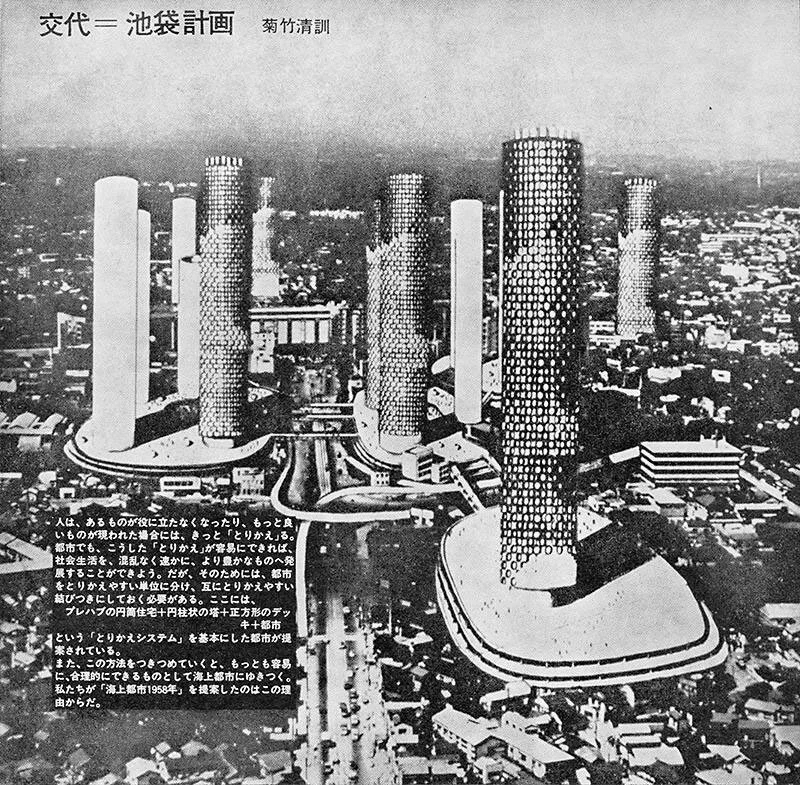
Marine City was more than than just an isle, it was a whole new society and ecosystem to live, and dwelling was a significant part of it. Models and sketches prove united states of america the programme he envisioned for information technology. The project was somewhat witty, a 300-meter residential skyscraper designed to adhere houses onto it.
To reach the plugging organisation, the tower had 2 of import components. First, a cylindrical cadre made of physical, which besides from physical stability, it worked as supplier of all basic needs of a modern house (electricity, calefaction, drinkable water, and other things). In sci-fi words, a tower-motherboard.
Second, a prefabricated residential capsule plugged onto the job. These units were program to have a lifespan of fifty years, then had to exist replaced. As the structure was the long-lasting element designed, the residential modules were disposable and effortlessly movable. All yous need was to detach them.
Several years subsequently the project saw public light, in 1975, Kikutake had a chance to realize it, partly as a pavilion called Aquapolis. The Okinawa Sea Expo - a world fair about marine life and oceanographic technologies - contacted Kiyonori Kikutake to design the centerpiece of the exposition. With the Marine Metropolis project in his mind, he constructed a floating self-sustaining semi-submergible artificial island. The pavilion was shut downwards in 1993 when tourists stop visiting it, and finally dismantled in 2000.


Marine City is a big statement in Kikutake's dream, but besides in Metabolism itself. It elucidates the group'due south intentions in their design. And besides, exemplifies the megastructure – plugged units' arrangement, a design style that identifies most of the grouping's projects. In the following years, the megastructure-units arrangement repeated and perfected itself until a last version was built.

Metabolism had way also many absurd moments we would like to hash out. From impressive buildings to futuristic installations to radical graphic designed manifestos, the group had many possibilities to develop their ideas in the virtually vibrant way.
Right now, we would similar to highlight iii of our favourite moments of this radical movement.
Osaka Expo '70
Expo 70 was a globe fair placed in Osaka prefecture in 1970, the first one e'er held in Japan. It consisted of an outsized international exhibition near countries' accomplishments in terms of compages, technologies, and economic development. Themed after the slogan Progress and Harmony for Flesh, the event aimed to display new promises of technology to achieve peace and stability to the globe.

The master plan of the expo was commissioned to Kenzo Tange, a prominent figure in gimmicky Japanese architecture. With the assist of another 12 architects - Metabolist group included - they designed and organized several elements for the fair.

Osaka became a playground for Metabolism, an empty field to test their ideas about future, equipment, and organic evolution. The results astonished, streets became total of life with space-age installations, colors flooded all 330 hectares of responsible terrain. Wonders congenital as a forecast of the time to come about to come.
As a cardinal slice of the fair, the designers conceptualized a place where people from around the globe could interact and socialize. The thoughts of a cover unified space where attendants could meet each other, they named it the Symbol Zone, a large plaza covered by a gigantic metal-framed roof.
In the centre of the plaza, you could find the Tower of Dominicus, a awe-inspiring sculpture made by Taro Okamoto. The lxx-meter-high tower was a representation of the different faces of the sun during seasons.


With more 64 meg attendees, and 77 countries invited to participate, the event was a consummate success. Too Japanese-designed installations, other nations had the opportunity to showcase their pavilions, and they did non disappoint at all.
Kurokawa's Manifiesto


In the same twelvemonth as the Osaka Expo was taking place, Metabolism founding fellow member Kisho Kurokawa decided to publish a volume examining the current land of the collective. "Kisho Kurokawa His Works: Capsule, Metabolism, Spaceframe, Metamorphose" is a volume published by Bijutsu Shuppan-Sha in 1970. The text contains documentation on the Expo 70 pavilion construction, his early works and approach to organic architecture.
In essence, this volume is thought of every bit a visual scrapbook. It was graphicly designed by Kiyoshi Awazu - a founding figure of the new wave of Japanese graphic design later WWII. Awazu was a known person in the collective, he had previously worked with them, creating their logo and the visuals for their manifesto published in 1960.
"Kisho Kurokawa His Works" was all an feel. Within the 27 cm 10 37 cm slice y'all could find two elements, an orangish-ruddy affiche virtually capsules also designed past Awazu, and likewise, a 7-inch vinyl tape entitled "Music for Living Space" created by Toshi Ichiyanagi, the infamous avant-garde musician.


Initially, the anthology as part of the music played at The Tower of Sun in the Expo lxx. It supposed to sound like the music for domestic life in the future decade. If y'all desire to hear Gregorian chants mixed with computer-generated sounds and Kukokawa's reciting phonation, the record is available on Youtube:
"Music For Living Space" (1969) was equanimous for the inner "Futurity Department" of the Sun Tower (太陽の塔) at the 1970 World Expo in Osaka (日本万国博覧会). A computer-gen...
As for the written content, the volume expresses Kurokawa'southward perspective on organic growth in architecture. He was interested in capsules and prefabricated forms of domicile, a new symbiotic relationship between settlings, units and, the man body. On the book he expands on this idea:
Article 1
The capsule is cyborg architecture. Human being, machine and space build a new organic body which transcends confrontation. As a human being being equipped with a man-made internal organ becomes a new species which is neither auto nor human, and then the sheathing transcends man and equipment.

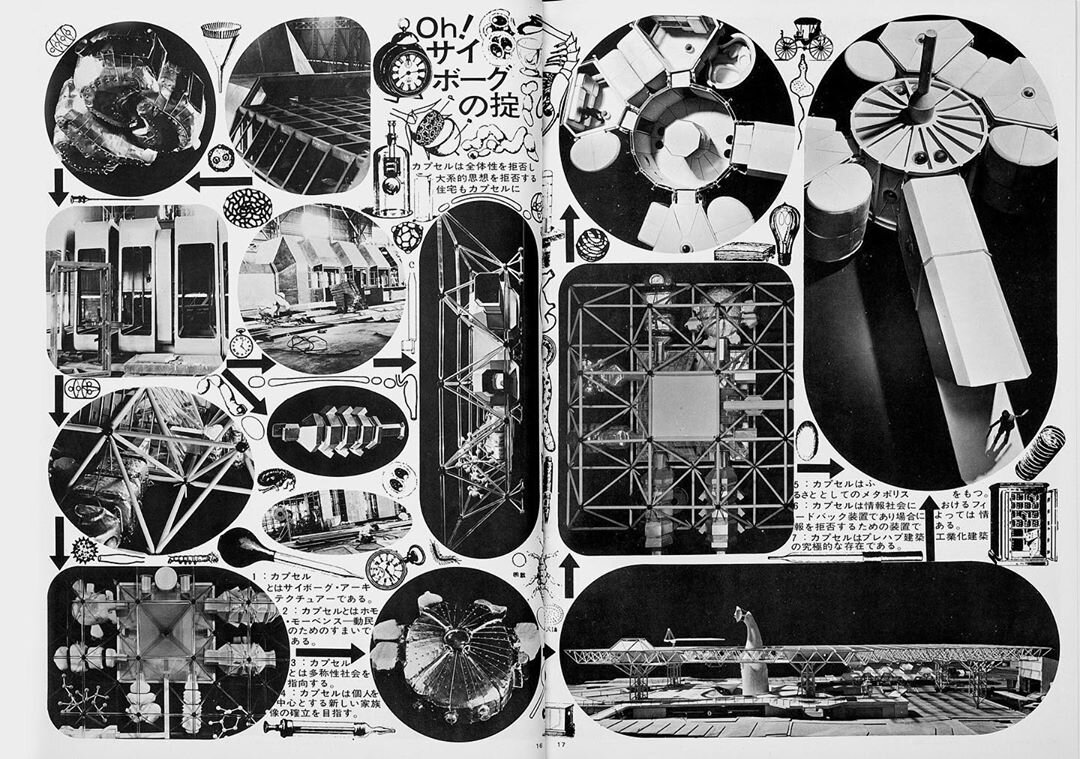
These thoughts are the establishment of his side by side step - and the last moment we would similar to visit in the Metabolism retentiveness: The materialization of his dream, the construction of Nakagin Capsule Belfry.
Nakagin Capsule Belfry

Nowadays, all interventions fabricated for the Metabolism collective seems to have disappeared. Osaka Expo seventy and Aquopolis were both dismantled. Other buildings from the group also met this fatal fate. However, a street of Ginza keeps until today a frozen moment from this radical commonage. The surprising Nakagin Capsule Tower.

Target at salarymen who needed a calendar week-days home, Nakagin Sheathing Tower is a residential Belfry built in Tokyo Nihon in 1972. Designed by Kisho Kurokawa, this building is the closest thing that the group got to materialize their dreams. A tower made of 140 dwelling capsules plugged onto two interconnected concrete cores.

The capsules were designed with prefabricated steel parts to be identical and compact. Equally the units measured two.5 1000 y 4.0 one thousand, every centimetre mattered to fit all the basic needs: a bath, a condition system, a storage space, a bed, and a desktop. The structure immune the capsules to be attached to a rigid framework. They were replaceable with a 30-twelvemonth lifespan.
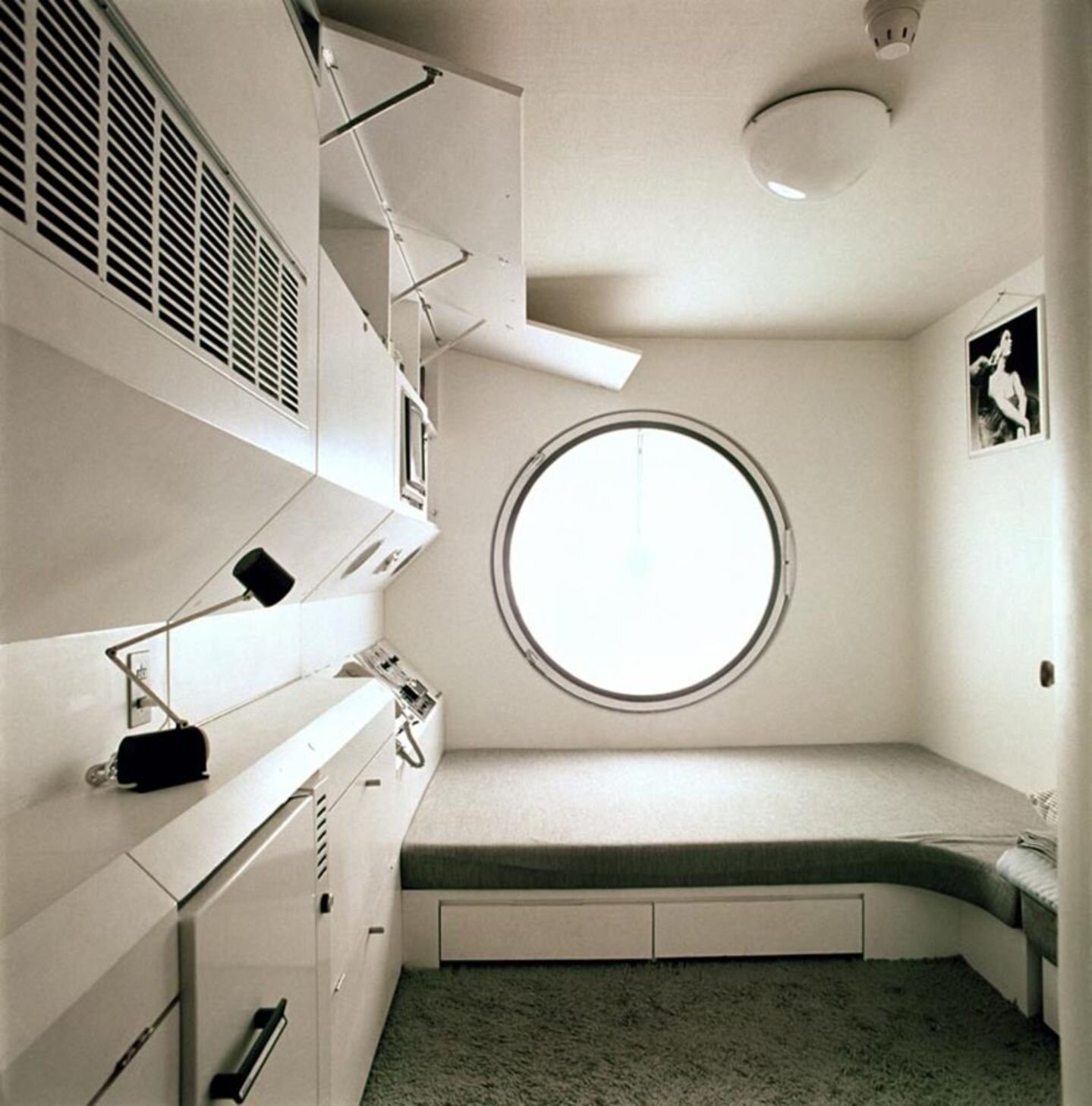
Although the original idea was to substitute the capsules with newer ones, it never happened. Currently, the building is facing decay for a long time, and even the abiding threat of demolishment. In 2007, 80 pct of the resident voted in favour of replacing the building with a newer 1.
In respond to this, Kurokawa proposed a renovation of the units with new ones. Only the projection evaporated with the passing of Kurokawa in 2007 and the recession of 2008.


Today Nakagin Sheathing Belfry represents a memory of a utopia never congenital, a rare materialized instance of experimental architecture from a post-war Nippon. In all likelihood, this building contains a bigger story that you could see at commencement glance, a narrative hidden in an over-urbanized Tokyo. A statement in technology and human life. A dream of future and modify.
Well-nigh THE AUTHOR:
Lucas Moreno is an architecture student based in Santiago, Republic of chile. He specializes in history, critic, and theory of Compages.
cunninghamcank1945.blogspot.com
Source: https://sabukaru.online/articles/the-promised-tokyo
0 Response to "When We Meet Again Architecture in Tokyo"
Post a Comment