Queering Families: the Postmodern Partnerships of Cisgender Women and Transgender Men
By Carla A. Pfeffer
Do you ever wonder how an author decided to write a volume or how a book embrace came to be? I often detect these to exist fascinating parts of the book creation procedure, merely areas that many authors don't say much about. In this mail service, I'm going to offer some of this background story on my book, Queering Families: The Postmodern Partnerships of Cisgender Women and Transgender Men.
fa·mil·iar
fəˈmilyər/
adjective
well known from long or close association.
noun
a demon supposedly attending and obeying a witch, oftentimes said to assume the class of an
animal.
Cultural Response to "Unfamiliar" Families
One of the starting time moments of awareness that I needed to write Queering Families occurred 1 afternoon while I was working on my dissertation with the television on for groundwork noise. Oprah Winfrey appeared, announcing that she had partnered exclusively with People magazine for an interview with Thomas Beatie, who the printing was dubbing, "the world's first pregnant homo." At that time, I'd been studying a group of fifty cisgender women partners of transgender men over the by three years and was excited to see one segment of the trans community covered on a forum that would, quite literally, reach millions of people. Over the next hr, Winfrey interviewed Thomas Beatie and his so-wife, Nancy. Winfrey followed the Beaties to Thomas' obstetrical appointments, peeked into his body through ultrasound images, and offered video vignettes of the Beaties' neighbors and life together in a suburban customs in Bend, Oregon.
What I found almost remarkable almost this hour of television was non so much Thomas Beatie, his pregnancy, his wife Nancy, or fifty-fifty the details of their twenty-four hour period-to-mean solar day family life. In many ways, their story actually seemed quite mundane. My focus, instead, was drawn to Oprah and her audience. Over the form of the hr, cameras panned and focused for close-ups upon viewers who appeared shocked and bewildered; in many instances, their mouths quite literally agape, slack-jawed, equally they stared at Thomas and Nancy and and so turned to one some other. Their faces mirrored defoliation and disbelief.

After the show aired, Internet chat rooms were abuzz with thousands of comments; their tones ranged from supportive to curious to overtly disgusted and irate. Simply put, many individuals were confused and shocked by these postmodern queer family unit forms nigh which they knew and understood very trivial.


[These are publicly-posted comments to internet chat rooms following Oprah'due south Beatie episode]
Family Trees and Judging a Book past its Cover
As I wrote the book, I connected to ponder the faces and reactions of those engaging with an unfamiliar family class. This focus continued throughout, and even after I finished the book and began to think most potential book cover designs. The book cover epitome my editor at Oxford Academy Press kickoff sent to me for consideration lit a fire under me. I immediately knew it was exactly something I did non want for the cover of this book. It had all the requisite components you might expect—a family tree, full with leaves and rainbow-colored boxes. It felt derivative, like it couldn't perhaps do justice to the circuitous stories and experiences with which I had been entrusted past my participants.

[Prototype available via Getty Images]
So I began searching through thousands of images to find something that felt more than plumbing equipment. I recognized it immediately when I finally institute it.
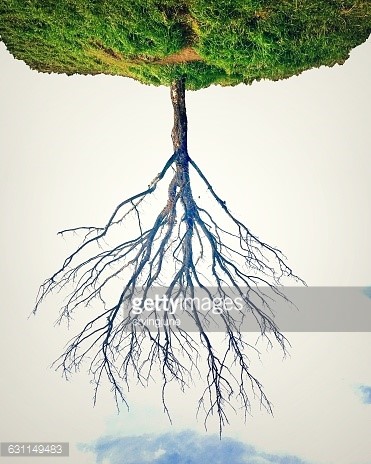
[Image available via Getty Images]
The epitome was recognizable still ambiguous, inverted—or was information technology? Were those barren branches or life-giving roots? Is that verdant and lush greenness leaf or moss-covered footing? Are those blueish clouds floating in the sky or a h2o source toward which the roots are stretching? In the branches/roots, where some might run into barrenness, Halloween, expiry, others might see something more arterial—a pathway for vital sustenance and growth. The bold starkness of the colors of the image seemed almost surreal, peculiarly juxtaposed against the often saccharine, nostalgic renderings of many family trees. In this epitome, there was no singular originary construction—a trunk; rather, information technology had an virtually rhizomatic quality to it. The image felt a bit like a confrontation, something you had to think almost rather than assume. Information technology was an epitome that left you a fleck unsettled fifty-fifty as it drew y'all in for a closer look. And it was also beautiful, simultaneously strong and frail, in transition—perhaps from season to season, from life to death, or death to life.
I was thrilled when the pattern team also liked the image I'd and then obviously fallen in honey with, just less thrilled when I saw the mock-up of the cover. They had placed a light-green overlay atop the image.

Originally, this irked me to no cease. I felt it minimized the distinctiveness and surreal quality of the colors in the original prototype, blending them into a more uniform and bland palate. Over time, information technology grew on me. I came to see it as the color of the heaven in the centre of a tornado—a warning that this is a heaven not to exist messed with or taken lightly. It was a color that simultaneously symbolizes queasiness, newness, growth, good fortune, perhaps fifty-fifty envy.
Familiar or Unfamiliar?
What I love most about the comprehend epitome is that it tends to movement the observer and their perceptions from background irrelevance to front and center. Unlike more than normative or anticipated images symbolizing families, the image is non so easily assimilated; rather, the viewer's estimation becomes requisite. Information technology challenges you lot to step out of passive inattention and into wondering, request, talking. And, in that moment, information technology is you lot and your perceptions that may be called into question, condign the subject.
The prototype is, in many ways, symbolic of the lives and families of the cis women I interviewed for the book project. Their relationships take been described by some every bit highly normative—reflecting a mirror epitome of 1950s housewifery in the 20-first century. Yet others sympathise their relationships every bit a complete inversion or even perversion of families and family life. In the volume, I explore the possibility that queer relationships and families bear no more and no less responsibility than whatsoever other types of relationships to socially conform or to subvert normativity. The book's title is meant to beg the question: Just who or what is doing the queering here? Practise we empathize cis women and their trans men partners and the families they create as the ones queering families? Ultimately, I contend that is incumbent upon all of us to consider how our perceptions, our interpretations, and our assumptions around families (and who and what gets to "count" as a family unit or family unit issues) hold the greatest potential to queer and transform these very concepts and institutions.
Dr. Carla Pfeffer is Associate Professor of Sociology and Women's and Gender Studies at the University of South Carolina and Chair-Elect of the Sexualities Section of the American Sociological Association. Pfeffer's enquiry on cisgender women's partnerships with transgender men has been published in theAmerican Periodical of Folklore, Gender & Society, Periodical of Marriage and Family unit, and the Journal of Lesbian Studies. Her volume,Queering Families: The Postmodern Partnerships of Cisgender Women and Transgender Men, was published by Oxford University Press (2017). Pfeffer's enquiry has been recognized through funding and awards from the Andrew West. Mellon Foundation, American Council of Learned Societies, National Council on Family unit Relations, and the sections on Sexualities and Sexual practice and Gender of the American Sociological Association. In a new collaborative and international project, funded past the Economical and Social Research Council, Pfeffer and colleagues will study transgender men's practices and experiences around reproduction and reproductive healthcare.
cunninghamcank1945.blogspot.com
Source: https://gendersociety.wordpress.com/2018/01/09/queering-the-familiar-genealogy-of-a-book-and-its-cover/
0 Response to "Queering Families: the Postmodern Partnerships of Cisgender Women and Transgender Men"
Post a Comment