What does Call Of Duty have to do with real-life war? A lot, it would seem
Immature soldiers inbound the Israeli Defense Force'south latest tank paradigm might find the interior oddly familiar. Tablet screens glow in the darkness displaying a map, armament and weapons, imitating the interfaces of contemporary shooting games. In place of a armed services-grade joystick, they bulldoze the tank using an Xbox controller.
This juxtaposition of war and play may seem chilling, but information technology is inappreciably new. The sophisticated human relationship betwixt the gaming industry and the military, sometimes dubbed the "military-entertainment circuitous", stretches dorsum decades.
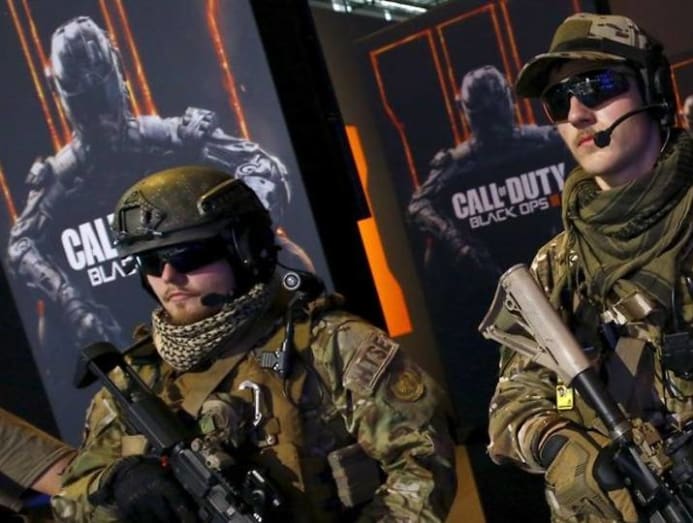
The US armed forces has explored the potential of game-like combat simulators since the 1980s. Today's "virtual training devices" range from tank gunner simulators then big they must be transported in shipping containers, to Date Skills Trainer, testing marksmanship and "shoot/don't shoot decisions", and Virtual Afghanistan, which is so immersive it has been used to assistance veterans suffering from PTSD revisit their trauma as a form of exposure therapy.
The early games built for military preparation, such as 2004's Full Spectrum Warrior, were accounted too unrealistic to be practically useful (though the game did later enjoy success when released as amusement).
Today, however, commercial gaming has outstripped the military's own projects in composure. Virtual Battlespace, used to train thousands of troops sent to Transitional islamic state of afghanistan, is adapted from the commercial Arma serial, popular for its realism.
Meanwhile military recruiters in the United states and Europe doggedly target gaming communities, perceived as desirable for their quick reflexes, tactical thinking and interest in new technologies. Last year a British army advert targeted "binge gamers" with a Telly spot and a 66-page gaming magazine supplement explaining "why the regular army loves your nonstop, push-mashing skills", part of a new entrada which helped the regular army striking its recruitment target for the commencement time in six years. The United states military went further by creating America'southward Army, a full video game designed for recruitment which launched in 2002 and was downloaded one.5m times in the outset half-dozen months of release.
The almost striking new avenue for armed services recruitment is the world of competitive gaming, or esports. The Dutch and British militaries take launched their own esports teams in social club to raise their profile among an attractive demographic.
The United states of america military sponsors several esports competitions and has developed a significant presence on video streaming platform Twitch, which reports it has 28m users a month and reaches lxxx per cent of teenage males in the US.
The use of Twitch as a armed services recruitment tool has drawn criticism for deliberately targeting minors, prompting congresswoman Alexandria Ocasio-Cortez to file a measure in congress last month to ban the U.s. military from streaming games for recruitment purposes. The measure was ultimately voted down. The description on the US Navy's Twitch page nevertheless reads: "Other people volition tell you not to stay upward all nighttime staring at a screen. We'll pay y'all to do it."
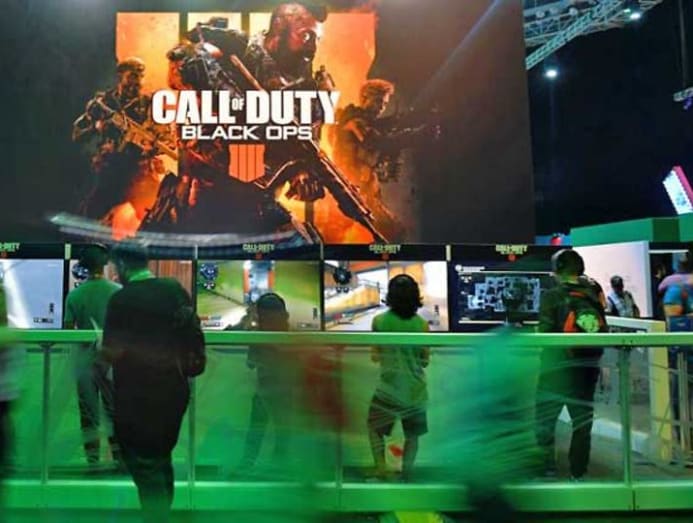
State of war remains an bonny subject for developers of commercial games, with armed forces series such as Call Of Duty and Battlefield becoming regular bestsellers. These tend to prefer a positive view of military operations and Us overseas appointment – games, still largely seen every bit entertainment products, struggle to counterbalance jingoism with the horrors of war as we might expect in films or literature.
Still, playing games that advantage brutality does not make us killers. For his 2004 book Generation Impale, journalist Evan Wright embedded with a group of young American soldiers entering Iraq in 2003, describing how, rather than being desensitised by their childhoods spent playing violent games, they were in fact traumatised by existent-world bloodshed, discovering "levels of innocence that they probably didn't think they had".
Almost troubling is not when games feel like war, merely rather when war is made to feel similar a game. Xbox controllers in tanks might not exist the focus here – joysticks were used in military operations long before they were adopted for games consoles – but we should question killing machines which are deliberately designed to dehumanise their targets.
Consider the drone pilot, practically a gamer, carrying out an assassination using a controller and a TV screen, operating in a space so abstract and distant information technology might also be virtual. Considering however much the targets in our very existent crosshairs resemble the pixelated baddies nosotros've dispatched past the 1000, no printing of a push volition allow them to respawn.
By Tom Faber © 2022 The Fiscal Times
cunninghamcank1945.blogspot.com
Source: https://cnalifestyle.channelnewsasia.com/entertainment/gaming-esports-military-call-of-duty-259121
0 Response to "What does Call Of Duty have to do with real-life war? A lot, it would seem"
Post a Comment